
Chemical Physics
Machine Learning Interatomic Potentials (MLIPs)
 In our group, we develop foundational machine learning interatomic potentials (MLIPs) that go beyond single-point energy predictions to enable more accurate and transferable molecular simulations. A key focus is designing advanced training strategies that enhance MLIP accuracy across diverse chemical environments while maintaining computational efficiency. We explore innovative approaches to extend MLIPs for molecular dynamics (MD) simulations, capturing long-timescale structural and dynamic properties with quantum-level accuracy. Additionally, we integrate MLIPs into transition state pathway predictions, enabling more efficient exploration of reaction mechanisms and energy landscapes. Recent efforts include:
- ECENet: An equivariant line-graph neural network based on the Edge Cluster Expansion, with persistent edge-centered representations and efficient O(2)-equivariant operations. ECENet is designed to combine high accuracy with computational efficiency for interatomic energy and force prediction, and can incorporate long-range electrostatics for molecular properties.
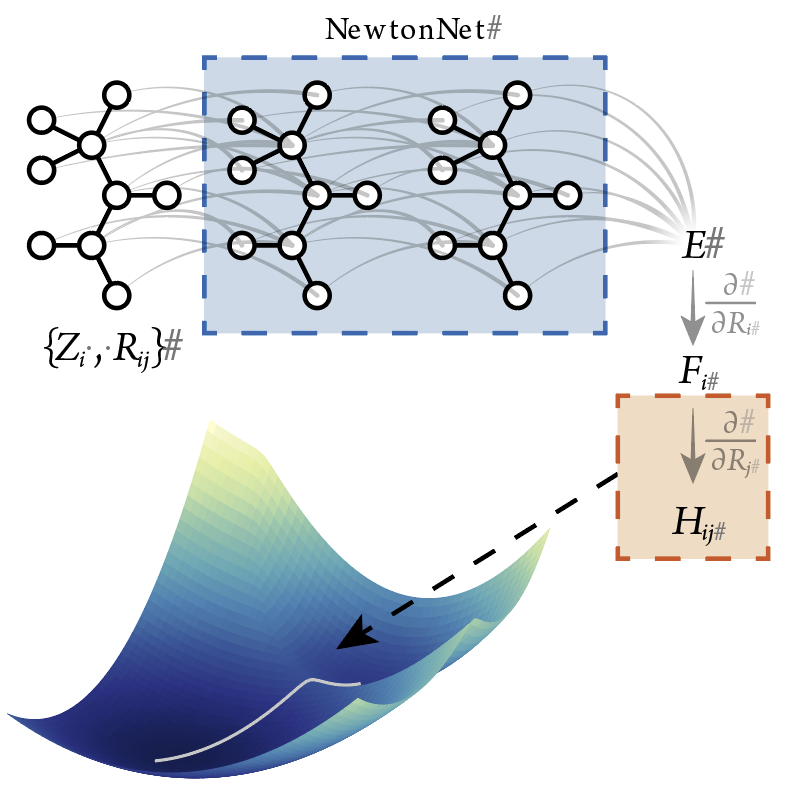
Paper · GitHub - NewtonNet and machine-learned Hessians: NewtonNet is a fully differentiable equivariant neural network potential that can provide analytical Hessians in addition to energies and forces. When trained on organic reactions, these learned Hessians can be used throughout transition-state optimization, substantially reducing the computational cost relative to direct DFT Hessian calculations.
Paper — Nature Communications · GitHub
Interfacial Water Structure, Reactivity and Spectroscopy
 We study how the structure of water at oil–water and microplastic–water interfaces is connected to spectroscopy and chemical reactivity. At oil–water interfaces, physics-based models connect Raman signatures with structural disorder and strong interfacial electric fields. At microplastic–water interfaces, ReaxFF–CGeM simulations link hydroxide coordination and dangling OH groups with fluorescence and polymer-dependent interfacial reactivity. Recent efforts include:
- Water structure and electric fields at oil droplets: Interface-selective Raman spectroscopy, together with a monomer-field model for Raman spectroscopy, reveals reduced tetrahedral ordering and weaker hydrogen bonding at oil–water emulsion interfaces, along with free OH groups and strong interfacial electric fields.
Paper — Nature - Monomer-Field Model for Raman spectroscopy: We predict the OH-stretch Raman spectrum of liquid water by describing how local electric fields perturb individual water molecules. It reproduces key features of the Raman spectrum and provides a framework for connecting local water environments with spectroscopic signatures.
Paper — J. Phys. Chem. Lett.
Completely Multipolar Model
 We develop advanced functional forms for energy decomposition models that enable fast and accurate molecular dynamics simulations. This work focuses on constructing detailed models of molecular interactions while retaining the efficiency needed for simulation, including applications to the density of water shown in our current work. Recent efforts include:
- CMM for many-body water interactions: The CMM framework uses a common multipolar functional form for the terms of an energy decomposition analysis, with behavior designed to remain well-defined at both long and short intermolecular distances.
Paper — J. Chem. Theory Comput. - CMM for water–ion and ion–ion interactions: CMM was extended to aqueous alkali-metal cations, halide anions, and their ion pairs. This work introduces environment-dependent atomic polarizability to account for the strong short-range damping associated with partially covalent ion interactions.
Paper — J. Phys. Chem. Lett.
Bond Rearrangement Descriptors
 We develop descriptors for understanding how chemical bonds rearrange. Polarizability provides an electronic observable and a basis for understanding bond rearrangements, while bond indices provide local, pair-specific information that can distinguish breaking and forming bonds. Recent work includes:
- Polarizability and bond-order flux: We showed that the change in Wiberg and Mayer bond indices along a reaction coordinate—termed bond flux—identifies bond-breaking and bond-forming points that are nearly equivalent to those obtained from bond-parallel polarizability. Because bond indices are pair-specific, bond flux also provides information about individual bond changes in reactions involving multiple rearrangements.
Paper — Phys. Chem. Chem. Phys.
M-Chem: An MD Engine
 M-Chem is being developed to perform classical molecular dynamics simulations and to extend to ab initio molecular dynamics and hybrid quantum mechanics/molecular mechanics functionalities. The goal is to support simulations of biomolecular systems ranging from thousands to several hundred thousand atoms.
Protein Sciences and Drug Discovery
Large Language Models for Drug Discovery
 We fine-tune large language models using drug discovery datasets to develop expert models for downstream tasks. These applications include de novo design, hit expansion, synthesis planning, fragment growing, and scaffold hopping. Recent efforts include:
- SmileyLlama: SmileyLlama adapts a general-purpose Llama model into a chemical language model through supervised fine-tuning and preference optimization. The resulting models can generate molecules in response to prompts specifying properties of interest for directed exploration of chemical space.
Paper — Nature Computational Science · GitHub - SynLlama: SynLlama fine-tunes Llama3 models to generate complete synthetic pathways using accessible building blocks and organic reaction templates. It is used for synthesis planning, generation of synthesizable molecular analogs, and hit expansion.
Paper — ACS Central Science · GitHub - LinkLlama: LinkLlama is designed for chemically reasonable fragment linking. It accepts prompts containing geometric constraints, such as distances and angles, together with physicochemical constraints to generate candidate molecules connecting specified fragments.
Paper — J. Chem. Inf. Model. · GitHub
Protein–Ligand Cofolding Models
 We investigate protein–ligand cofolding models for allosteric drug discovery. Our current work includes CAFE, a cofolding protocol that uses competitive orthosteric blockers to divert fragments toward non-canonical binding sites. Recent efforts include:
- CAFE: Co-folding Approach for Fragment Exploration (CAFE) is a training-free, inference-time protocol that introduces competitive orthosteric blockers during cofolding to divert fragments away from canonical orthosteric sites. It enables exploration of allosteric and cryptic binding sites using fragment libraries.
Paper — bioRxiv · GitHub - KinConfBench: KinConfBench is a curated benchmark for testing whether protein–ligand cofolding models recover ligand-associated conformational states of protein kinases. The benchmark contains 2,225 high-quality human kinase chains and evaluates Boltz-2, Chai-1, Protenix, and RoseTTAFold-All-Atom.
Paper — npj Drug Discovery · GitHub
Intrinsically Disordered Proteins (IDPs)
 More than 60% of human proteins contain intrinsically disordered regions for which structural prediction models cannot provide a single defined structure. We develop diffusion models that generate IDP and IDR ensembles that agree with experimental data. Recent efforts include:
- IDPForge: IDPForge is a transformer protein-language diffusion model that generates all-atom ensembles for fully disordered proteins and for disordered regions while maintaining accompanying folded domains. The generated ensembles show agreement with solution experimental data, and the model can also incorporate experimental restraints during sampling.
Paper — bioRxiv · GitHub - AlphaFlex: AlphaFlex uses IDPConformerGenerator or IDPForge to generate atomistic conformational ensembles for proteins containing predicted disordered regions while retaining high-confidence folded domains from AlphaFold2. The project applies this workflow across the human proteome to provide ensemble representations for proteins containing IDRs.
Paper — bioRxiv